
Kynzora by KP Travels
Kynzoraby KP Travels
Home/Maharashtra Tour Packages/Panch Jyotirlinga Yatra
16+ Years Legacy • 1,00,000+ Happy PassengersAll 5 Maharashtra JyotirlingasPrivate Chauffeur Standby

Panch Jyotirlinga Yatra from PuneAll Five Maharashtra Jyotirlingas in 5 Days & 4 Nights

Maharashtra holdsfive of India's twelve Jyotirlingas — more than any other state. This chauffeur-driven loop from Pune covers all of them:Bhimashankar,Trimbakeshwar,Grishneshwar,Aundha Nagnath andParli Vaijnath, with the Ellora Caves and Shirdi available as en-route additions.

Shrines Covered
5 JyotirlingasAll five that lie in Maharashtra
Duration
5D / 4NFour night halts on the circuit
Approx. Distance
~1,250 kmRound trip from Pune
Vehicles
Sedan to Tempo4 to 26 seats, all air-conditioned
Doorstep pickup across Pune Chauffeur on standby all 5 days Written quotation before payment
Shiva temple shikhara on the Panch Jyotirlinga circuit of Maharashtra covered by KP Travels from Pune
5 Days / 4 Nights Circuit
Bhimashankar • Trimbakeshwar • Grishneshwar • Aundha • Parli

From ₹11,999 · Private AC vehicle with dedicated chauffeur

The Route Arc

Five Jyotirlingas, One Loop Across Maharashtra

The circuit arcs north-west from Pune into the Sahyadri, swings east across the Godavari basin to Verul, then drops south through Marathwada before closing back at your doorstep. Driven in this order, no shrine is approached twice and the longest single stretch is saved for the final day.

Jyotirlinga 01

Bhimashankar

01
Pune district, MaharashtraSahyadri (Western Ghats)

Bhimashankar stands at the source of the Bhima river in the Sahyadri range, wrapped in the Bhimashankar Wildlife Sanctuary. Tradition connects the shrine to Shiva's destruction of the demon Tripurasura, and the sweat of that battle is said to have formed the river below. The temple is built in the Nagara style with later Maratha-period additions, and the forest around it is one of the last strongholds of the Indian giant squirrel.

From Puneapprox. 110 km3 – 3.5 hrs of driving
Terrain & AltitudeRoughly 900 m above sea level. A long flight of steps leads down to the temple.

Expect a descent and climb of a few hundred steps between the parking area and the sanctum. Carry water and allow extra time if elders are travelling.
Jyotirlinga 02

Trimbakeshwar

02
Nashik district, MaharashtraBrahmagiri hill, near Nashik

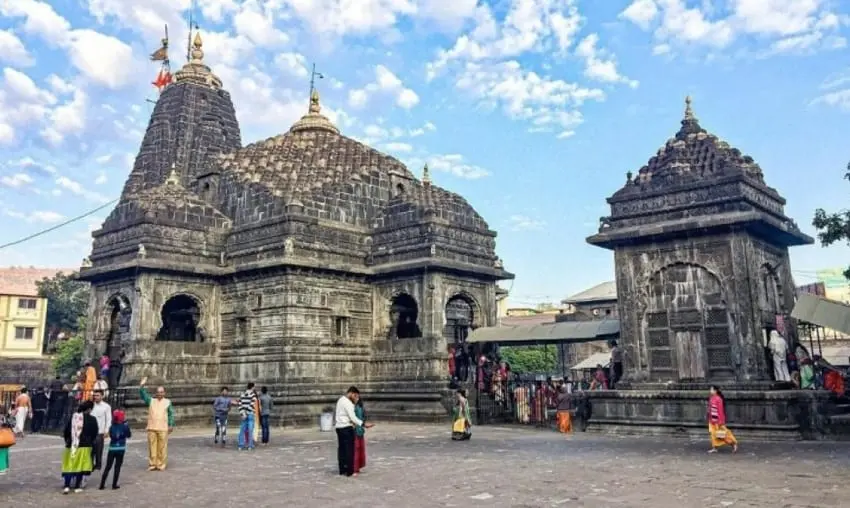
Trimbakeshwar sits at the source of the Godavari, the longest river of peninsular India. Its linga is unusual — three small faces representing Brahma, Vishnu and Shiva rather than a single shaft. The present black stone temple was built in the eighteenth century under Peshwa Balaji Bajirao. The town is also the traditional place for Narayan Nagbali and Kaal Sarp rituals, which is why the surrounding lanes are busy through most of the year.

From Bhimashankarapprox. 230 km5 – 6 hrs of driving
Terrain & AltitudeAt the foot of Brahmagiri hill. Temple courtyard is walkable; the hill trek is optional and steep.

The sanctum queue can be long, and the separate Brahmagiri climb involves several hundred stone steps. Treat the trek as optional, not part of the standard darshan.

Jyotirlinga 03

Grishneshwar

03
Chhatrapati Sambhajinagar (Aurangabad) districtVerul, beside the Ellora Caves

Grishneshwar, also called Ghrishneshwar, is traditionally counted as the last of the twelve Jyotirlingas. The red basalt temple at Verul was rebuilt in the eighteenth century by Ahilyabai Holkar of Indore, and its carved shikhara and pillared hall are among the finest examples of that revival. It stands barely a kilometre from the Ellora Caves, which makes it the natural point to add a UNESCO World Heritage half-day to a temple circuit.

From Trimbakeshwarapprox. 200 km4.5 – 5 hrs of driving
Terrain & AltitudeLevel ground. The easiest of the five to reach and walk.

Male devotees are traditionally asked to enter the sanctum bare-chested. Mobile phones and cameras are usually not permitted inside.

Jyotirlinga 04

Aundha Nagnath

04
Hingoli district, MarathwadaAundha town

Aundha Nagnath is the quietest of the five and, for many pilgrims, the most rewarding. The temple is associated in local tradition with the Pandavas of the Mahabharata and with the saint Namdev, and the surviving structure carries Hemadpanti stonework of the Yadava period. The sanctum lies below the level of the courtyard, so the darshan involves stepping down into the shrine rather than up into it.

From Grishneshwarapprox. 210 km4.5 – 5 hrs of driving
Terrain & AltitudeFlat Marathwada plateau. Short walk from parking to the temple.

Crowds here are usually modest outside Mahashivratri and Shravan Mondays, which often makes this the calmest darshan of the tour.

Jyotirlinga 05

Parli Vaijnath

05
Beed district, MarathwadaParli town, on a small hill

Parli Vaijnath is linked in tradition to the physician form of Shiva, Vaidyanath, and to healing — devotees have long come here with prayers for recovery from illness. The temple was substantially restored in the eighteenth century under the patronage of Ahilyabai Holkar. Its wide stone courtyard is unusual among the five: pilgrims are permitted to touch the linga during darshan at set times, subject to the temple administration's rules on the day.

From Aundha Nagnathapprox. 130 km3 – 3.5 hrs of driving
Terrain & AltitudeTemple sits on a low hill with a stepped approach to a large open courtyard.

A stepped approach leads up to the courtyard. The return leg to Pune from here is the longest single drive of the circuit.

Closing the loop from Parli Vaijnath back to Pune adds roughly 370 kilometres through Beed and Ahmednagar, taking the full circuit to about 1,250 kilometres. All distances on this page are approximate road distances and vary with the exact pickup address and the route conditions on the day.

Day By Day

The 5 Days / 4 Nights Itinerary

One shrine on most days, with the vehicle and chauffeur staying with you between temples. Halt towns are confirmed in writing before departure and can be shifted to suit your group.

Customise this plan: +91 97650 66565
Day 1

Pune to Bhimashankar, then on toward Nashik

Approx. 110 km to Bhimashankar

An early doorstep pickup anywhere in Pune. The drive climbs into the Sahyadri through Rajgurunagar and Manchar, reaching Bhimashankar in about three hours. After darshan and the walk back up from the sanctum, the vehicle continues north for the night halt so that Day 2 begins close to Trimbakeshwar. Leaving Pune before sunrise is strongly recommended — Bhimashankar's queue lengthens sharply through the morning.

  • Doorstep Pune pickup
  • Bhimashankar darshan
  • Sahyadri ghat drive
  • Night halt en route to Nashik
Day 2

Trimbakeshwar darshan and Nashik

Approx. 230 km from Bhimashankar

Morning darshan at Trimbakeshwar at the foot of Brahmagiri hill, the source of the Godavari. The rest of the day is deliberately unhurried: the Kushavarta Kund, the temple lanes and, if you have the appetite for several hundred steps, the optional Brahmagiri climb. Travellers who want to add Shirdi usually insert it on this leg, since it sits within a comfortable drive of Nashik. Night halt in or near Nashik.

  • Trimbakeshwar darshan
  • Kushavarta Kund
  • Optional Brahmagiri climb
  • Optional Shirdi add-on
Day 3

Nashik to Grishneshwar with the Ellora option

Approx. 200 km

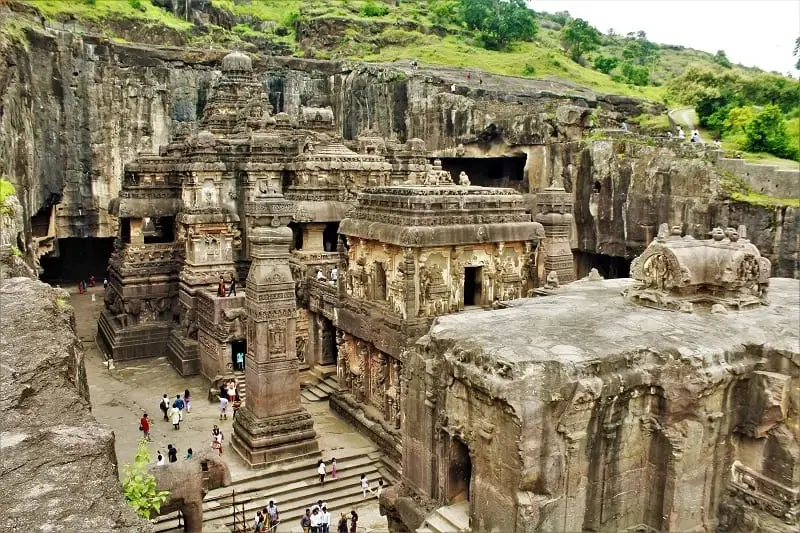
The drive east crosses into Marathwada and reaches Verul by early afternoon. Grishneshwar is the easiest walk of the five, so this is the day most groups also use for the Ellora Caves, roughly a kilometre away. Ellora is a UNESCO World Heritage Site with thirty-four rock-cut Buddhist, Hindu and Jain excavations, including the monolithic Kailasa temple. Entry tickets are paid at the gate and are not part of the package. Night halt in Chhatrapati Sambhajinagar (Aurangabad).

  • Grishneshwar darshan
  • Ellora Caves (optional, tickets extra)
  • Kailasa temple
  • Night halt in Chhatrapati Sambhajinagar
Day 4

Aundha Nagnath in Hingoli

Approx. 210 km

A straightforward Marathwada plateau drive to Aundha. This is typically the quietest darshan of the yatra, and the Hemadpanti stonework rewards a slow walk around the courtyard before you step down into the sanctum. Depending on your arrival time, the chauffeur either halts at Aundha or continues toward Parli so that Day 5 starts short. Night halt as confirmed in your written plan.

  • Aundha Nagnath darshan
  • Hemadpanti temple courtyard
  • Marathwada drive
  • Night halt near Aundha or Parli
Day 5

Parli Vaijnath and the return to Pune

Approx. 130 km, then approx. 370 km back to Pune

Morning darshan at Parli Vaijnath completes the five. The return drive to Pune runs roughly 370 kilometres through Beed and Ahmednagar and is the longest single stretch of the circuit, so an early darshan matters. Your chauffeur drops the group back at the same doorstep address in Pune. Groups who prefer to break this leg sometimes add a night at Ahmednagar or a Shani Shingnapur halt — tell the tours desk in advance so the kilometres are re-quoted.

  • Parli Vaijnath darshan
  • Beed and Ahmednagar highway
  • Optional Shani Shingnapur halt
  • Doorstep Pune drop

Temple timings, aarti schedules and queue lengths are set by each temple administration and can change without notice. The driving order above is planned to give you the best chance of an early darshan, not a guaranteed one.

Optional Stops

Ellora Caves and Shirdi, Added En Route

Two of Maharashtra's most visited destinations happen to sit almost exactly on this circuit, which is why most groups fold at least one of them in rather than making a separate trip later.

Ellora Caves, about 1 km from Grishneshwar

A UNESCO World Heritage Site with thirty-four rock-cut Buddhist, Hindu and Jain excavations carved into a basalt escarpment, including the monolithic Kailasa temple cut downward from a single rock face. Because Grishneshwar is the shortest walk of the five shrines, Day 3 usually has room for a half day here without disturbing the rest of the plan. Entry tickets and camera fees are paid at the gate and are not part of the package.

Shirdi, on the Nashik leg

The Sai Baba Samadhi Mandir at Shirdi sits within a comfortable drive of the Nashik halt, so it is most often added around Day 2. Some groups instead add Shani Shingnapur on the return drive from Parli. Either addition changes the total kilometres for the yatra, so ask the tours desk to re-quote before you confirm the plan.

Rock-cut temple architecture near Verul, close to the Grishneshwar Jyotirlinga in Maharashtra
Stone Shiva temple in Maharashtra of the kind visited on the Panch Jyotirlinga yatra
Transparent Rate Card

Choose Your Vehicle for the Yatra

The package starts from ₹11,999. Any driving beyond the confirmed itinerary is billed on the published outstation rates below. Driver allowance ₹500 per day, night halt ₹500 per night. Toll and parking extra.

4 Passengers

AC Sedan

Dzire / Etios

Per km₹13 / km
Min. daily average250 km / day
Luggage2 large bags
Driver allowance ₹500 / dayNight halt ₹500 / night

Couples and two-person darshan trips.

Book This Vehicle
6 Passengers

Prime SUV

Maruti Ertiga

Per km₹16 / km
Min. daily average250 km / day
Luggage3 large bags
Driver allowance ₹500 / dayNight halt ₹500 / night

Small families who want extra legroom on ghat sections.

Book This Vehicle
7 Passengers

Innova Crysta

Luxury SUV

Per km₹22 / km
Min. daily average250 km / day
Luggage4 large bags
Driver allowance ₹500 / dayNight halt ₹500 / night

The most requested vehicle for a five-day temple circuit.

Book This Vehicle
13+ Passengers

Tempo Traveller

13–26 Seater

Per km₹32 / km
Min. daily average300 km / day
LuggageLarge boot space
Driver allowance ₹500 / dayNight halt ₹500 / night

Bhajani mandals, extended families and society groups.

Book This Vehicle

A five-day circuit of roughly 1,250 kilometres comfortably clears the minimum daily average on every category, so the quoted figure is driven by actual kilometres rather than by a shortfall charge.

No Fine Print

What the Package Covers, and What It Does Not

Written out plainly so there is nothing to discover at the end of the yatra.

Inclusions

  • Private air-conditioned vehicle for the full 5 Days / 4 Nights circuit with the chauffeur on standby each day
  • Verified chauffeur experienced on Sahyadri ghat roads and Marathwada highways
  • Fuel for every sightseeing and inter-temple transfer within the confirmed itinerary
  • Driver allowance and night halt charges exactly as stated in your written quotation
  • Doorstep pickup and drop anywhere within Pune city limits
  • Day-wise route planning with the driving order arranged around temple timings
  • A single point of contact at the Pune tours desk for the whole yatra

Exclusions

  • Pooja, abhishek, archana and any special darshan or paid queue charges at the temples
  • Temple donations, offerings and priest dakshina
  • Ellora Caves entry tickets, camera fees and licensed guide charges
  • Hotel accommodation, unless you specifically ask us to arrange it and it is quoted to you in writing
  • Breakfast, lunch, dinner and all beverages for the travelling party
  • Toll, parking and interstate charges where not stated in your confirmation
  • Personal expenses, shopping, tips and anything not listed under inclusions
Honest Guidance

What to Know Before the Yatra

A darshan circuit is not a sightseeing tour. These are the four things that most affect how the five days actually feel.

Steps and walking

Bhimashankar involves a descent and climb of several hundred steps, and Trimbakeshwar's optional Brahmagiri trek is steeper still. Grishneshwar and Aundha Nagnath are close to level ground, while Parli Vaijnath has a stepped approach to its courtyard. Comfortable footwear that is easy to remove matters more than anything else you pack.

Darshan queues vary

We cannot promise a waiting time at any shrine. Mondays are the busiest day of the week at Shiva temples, and the entire month of Shravan, along with Mahashivratri, draws very heavy crowds at Bhimashankar and Trimbakeshwar. Weekday darshan outside these periods is usually far quicker.

Temple rules

Each temple sets its own rules on dress, photography, mobile phones and sanctum entry, and those rules change without notice. At Grishneshwar male devotees are traditionally asked to enter bare-chested. Leather items are commonly restricted. Follow the instructions of the temple staff on the day.

Best months to travel

October to February gives the most comfortable driving and walking weather across both the Sahyadri and Marathwada. The monsoon turns Bhimashankar spectacularly green but the steps become slippery and the ghat drive slower. April to June is hot on the Marathwada legs.

Simple Booking

Booking the Yatra Takes Three Steps

01

Share your dates and group size

Tell the tours desk your travel window, the number of travellers and whether any elders are joining, so the walking-heavy stops can be paced correctly.

02

Confirm vehicle and rate in writing

Choose the vehicle category that fits the group. You receive the per-kilometre rate, driver allowance and night halt figures before anything is paid.

03

Chauffeur assigned before departure

Driver name, phone number and vehicle registration are shared ahead of the pickup morning, so you know exactly who is arriving at your door.

Why pilgrims book KP Travels for this yatra

Sixteen years of Pune-based road travel, a real dispatch room and chauffeurs who have driven the Sahyadri ghats and the Marathwada highways many times over.

16+ Years of Pune Dispatch

KP Travels has been running road travel out of Pune for over sixteen years, with more than 1,00,000 happy passengers on record.

Written Quote, No Surge

Vehicle category, per-kilometre rate, driver allowance and night halt are confirmed in writing before payment. Shravan weekends do not change the agreed figure.

Chauffeurs Who Know the Route

Drivers familiar with the Bhimashankar ghat, the Trimbakeshwar approach and the long Marathwada stretches between Aundha and Parli.

A Real Desk, Not an App

Pune dispatch on +91 90116 16565 and the tours desk on +91 97650 66565, reachable through every day of the yatra.

KP Travels Head Office

89/300 Laxmi Nagar, Near Parvati Police Station, Pune 411009, Maharashtra

Got Questions?

Panch Jyotirlinga Yatra FAQs

Shrines covered, walking involved, darshan queues and how the vehicle is charged.

How many Jyotirlingas are in Maharashtra and which ones does this yatra cover?

Of the twelve Jyotirlingas in India, five lie within Maharashtra — more than any other state. This yatra covers all five: Bhimashankar in Pune district, Trimbakeshwar near Nashik, Grishneshwar at Verul beside the Ellora Caves in Chhatrapati Sambhajinagar (Aurangabad) district, Aundha Nagnath in Hingoli district and Parli Vaijnath in Beed district. The circuit is planned as a single loop from Pune so that no shrine is driven to twice.

What is the duration and starting price of the Panch Jyotirlinga package?

The package runs 5 Days / 4 Nights and starts from ₹11,999. That covers a private air-conditioned vehicle with a chauffeur on standby for the whole circuit, fuel, driver allowance and the day-wise route planning. Pooja and abhishek charges, temple donations, Ellora entry tickets, meals and hotel stay are not included unless separately quoted to you in writing.

How much walking and how many steps are involved?

Bhimashankar is the most demanding: the temple sits below the parking area and reaching the sanctum means a descent and climb of several hundred steps. Trimbakeshwar's main temple is easy to walk to, but the optional Brahmagiri hill climb is a long stone stairway that most groups skip. Grishneshwar and Aundha Nagnath are near level ground, and Parli Vaijnath has a stepped approach to a wide courtyard. If elders are travelling, tell the tours desk in advance so the day order and halt timings can be paced for them.

How long will the darshan queue be at each temple?

We cannot guarantee any waiting time, and we will not claim otherwise. Queues depend entirely on the day and the season. Mondays are the busiest day at every Shiva temple, and the month of Shravan and Mahashivratri bring very large crowds to Bhimashankar and Trimbakeshwar in particular. Aundha Nagnath is usually the quietest of the five. Travelling on weekdays outside the peak periods and reaching each shrine early in the morning is the most reliable way to keep waiting short.

Can Ellora Caves and Shirdi be added to the itinerary?

Yes, and both are common additions because they sit naturally on the route. Ellora is roughly a kilometre from Grishneshwar, so a half day there fits into Day 3 with no extra driving; entry tickets are paid at the gate. Shirdi fits most easily around the Nashik leg on Day 2. Shani Shingnapur is sometimes added on the return drive to Pune. Any addition changes the total kilometres, so ask the tours desk on +91 97650 66565 to re-quote before you confirm.

Do you arrange pooja, abhishek or special darshan passes?

No. We do not arrange or collect money for pooja, abhishek, archana, priest bookings or paid darshan queues, and we do not quote a fee for them. Those arrangements are made directly by devotees with the temple administration or with a priest at the shrine, and the rates are set by the temple, not by us. Our responsibility is the vehicle, the chauffeur and getting you to each temple on schedule.

How is the vehicle charged if we extend the yatra or change the route?

Any driving beyond the confirmed itinerary is billed on our published outstation rates: ₹13 per km for an AC Sedan, ₹16 per km for an Ertiga, ₹22 per km for an Innova Crysta (each with a 250 km per day minimum average) and ₹32 per km for a Tempo Traveller (300 km per day minimum average). Driver allowance is ₹500 per day and night halt is ₹500 per night, with toll and parking extra. Every revision is re-quoted in writing before you agree to it.

Plan Your Panch Jyotirlinga Yatra

Share your dates and group size with our Pune tours desk and receive a written5 Days / 4 Nights plan with the vehicle, rate and halts confirmed before you pay anything.